Casey councillors have unanimously approved a controversial planning permit to turn the northern half of the Cranbourne Golf Course into almost 500 homes, repeatedly claiming during debate that State housing targets and zoning history left them with little room to refuse the proposal.
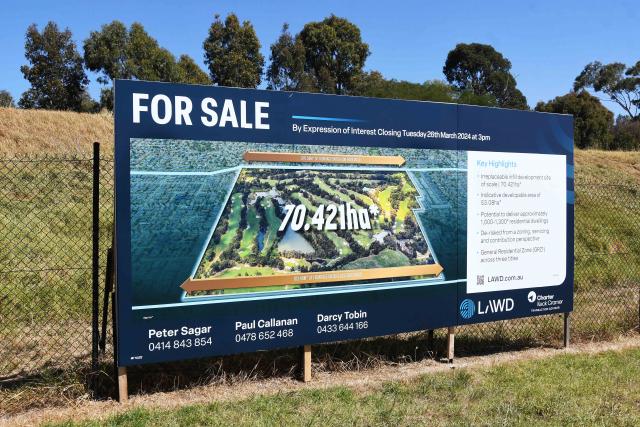
At the Casey Council February Meeting on Tuesday 17 February, councillors backed a permit allowing up to 499 new dwelling lots at the existing Cranbourne Golf Course at 750 Glasscocks Road in Cranbourne North, subject to conditions. About 121 dwelling lots will be under 300 square metres.
The developer Brown Property Group has envisioned more than 1000 new homes ultimately across the entire golf course, but the application for the southern part has yet to be lodged.
Council officers recommended granting a permit, saying the site was already zoned residential, had no overlays restricting development, and represented one of the few remaining strategic locations capable of delivering a large number of homes toward Casey’s dwelling quota.
Officers also cited “additional public benefits” offered by the developer, such as the “overprovision” of public open space land, which would be 12.4 per cent instead of the minimally required 8 per cent; delivery of Greening Casey policy targets of 30 per cent canopy cover in streets and public open spaces and 20 per cent canopy cover across the subject site through planting of thousands of new canopy trees (with most of the existing 3800 plus trees removed first for the development); a prohibition on artificial grass and encouragement of lighter-roofed, non-reflective roof materials; and a voluntary financial contribution for social infrastructure.
Cr Kim Ross, whose ward contains the golf course, first acknowledged the community’s concerns about increased traffic, increased demand on local infrastructure, including schools, sporting recreation facilities, and maternal health, a lag in connectivity of bus services, a reduction in greenery, the proximity to the Hallam Road landfill and the proposed waste transfer station nearby. However, she pointed to several “really, really important facts” for her decision to support the permit, including the residential zoning history and the State’s housing target quota for each council.
“The State Government has a housing target in established areas for Casey of 28,500 homes over the next 30 years. This redevelopment is a key part of us meeting that target,” she said at the Meeting.
“If we do not meet the target, the State Government has the power and the will to come in and impose their own way of meeting it.
“The 499 dwelling lots go a long way to helping with this target. The size of some of the blocks may sit uncomfortably for some, but this is a no-judgment zone.
“They provide an affordable housing option for many in the community and add to a much-wanted diversity of stock. It’s in this space that good design makes a considerable difference to the livability, regardless of how small or big the block is.”
Cr Ross said she would continue to advocate to the State Government for improved bus services, safer connections with local roads, appropriate school provisions, and to the council to identify areas in the surrounding neighbourhood where more intense tree planting and urban heat cover could be implemented, to address pedestrian connectivity with local amenities and to monitor the use and capacity of local amenities.
Cr Lynette Pereira echoed Cr Ross’ sentiment, describing council as “limited and restricted” by the planning framework, despite the “angst” in the community.
She spoke about the subject site’s proximity to the landfill, satisfied with the Council Officers’ recommendation that a reduced buffer distance of 1,000 metres would suffice after they independently peer reviewed the developer-commissioned Qualitative Risk Assessment.
Previously, residents have asked for a quantitative assessment, but there is no evidence that the developer or the council have commissioned it.
Despite the unanimous voting towards the end of the debate, several councillors expressed unease.
Deputy Mayor Cr Michelle Crowther questioned whether the planning system was heading toward “housing at all costs”.
“The Delegate Report states the retention of 55 canopy trees would conflict with the ability to develop the land with dwellings to meet housing needs. This issue has weighed heavily on my mind…” she said at the Meeting.
“Poor tree canopy makes the area hotter, as Cr Ross described before, more expensive to cool, and I feel it often disproportionately impacts our lower-income residents who are living in these higher-density areas. It’s often our most vulnerable community members who are paying the price of these planning choices.”
She also raised concerns about small lot sizes, with some homes proposed on blocks as small as 117 square metres, and she also pointed out that the nearest activity centre is about 800 metres away without an existing bus route.
“The Casey planning scheme requirement of eight per cent open space applies, and this application does exceed that. But beyond this application, perhaps we should be having a conversation about whether these minimum standards in the planning scheme are adequate to protect our future residents’ quality of life and the impacts on their physical and mental health,” she said.
“As others have spoken to, it is a challenge. This proposal does meet the minimum standards in the Casey planning scheme, and this is the framework we must use to make our decision. But perhaps outside this application, we really need to have a conversation about what our community wants for the future.”
Cr Dave Perry said at the Meeting that the permit was hard to support.
“Unfortunately, what we’ve come to understand is our planning system now more than ever takes decisions away from locals who feel they know their area best,” he said.
“There’s a push to build through what’s being framed as a housing crisis in Victoria and Australia. They’ve taken away as much power as possible.
“They gave locals a say on what’s appropriate in their communities. And the State is saying we must build more homes.”
Mayor Cr Stefan Koomen said while community frustration was understandable, the council had achieved the “best possible outcome” with the “additional public benefits”.
“I think it will be a liveable and nice space to live, and we’ve got the best outcome we can, given the circumstances,” he said at the meeting.
Star News previously reported community opposition to the development over traffic congestion, the loss of green space, the capacity of local infrastructure, and the risk of landfill odour.
About 51 objections were received during the notice period.
Councillors added three amendments before voting unanimously, requiring social infrastructure contributions to be spent locally, strengthening enforcement of the 30 per cent street and 20 per cent site-wide canopy targets, and mandating stage-by-stage tree protection plans to maximise retention during construction.
Casey Residents and Ratepayers Association (CRRA) president Anthony Tassone said residents were worried about what the scale of development would mean for “amenity, infrastructure and liveability”, arguing council relied on developer-commissioned assessments to justify reduced landfill buffers without seeking independent odour or gas risk testing.
He said the Supreme Court’s finding that nearby landfill operator Veolia breached its environmental duties made independent scrutiny “even more important”, while also criticising the council for not applying the State’s golf course redevelopment guideline of at least 20 per cent public open space.
“Residents understand the need for more housing,” Mr Tassone said.
“What they are asking for is responsible growth, with truly independent evidence assessing the risk, transparent decision-making, and infrastructure and services delivered in step, not after the fact.”