Casey commuters say the new Metro Tunnel service on the Cranbourne and East Pakenham lines has made travelling to the city more time-consuming, less convenient, and stressful.
The changes have sparked heated discussion in local Facebook community groups, where Cranbourne and East Pakenham line commuters have been sharing experiences and concerns about the new travel patterns.
Many locals have reported longer commute times to the city, extra steps, mobility issues, the loss of direct access to key city stations, and further mental stress.
Casey Residents & Ratepayers Association (CRRA) president Anthony Tassone said resident feedback on the Metro Tunnel ‘Big Switch’ is clear: there are winners and losers.
“Right now, the pain is falling most heavily on south-east commuters who’ve lost their one-seat ride into the City Loop and key inner-city stations,” he said.
The city’s mega-project, the $13.5 billion Metro Tunnel, was fully launched on Sunday 1 February. Hailed as the biggest network change since the City Loop 40 years ago, the Metro Tunnel links the Cranbourne and East Pakenham lines in the south east with the Sunbury line in the north west.
Under the new arrangements, Cranbourne and East Pakenham lines now run directly through new CBD stations at Town Hall, State Library, Anzac, Parkville, and Arden, bypassing the City Loop, South Yarra, and Richmond.
Transport planners have said the new routing is intended to reduce congestion in the City Loop and free up capacity at Flinders Street and Southern Cross, while creating a high-frequency rail spine through the CBD.
Nicole Edgar from Narre Warren South, who has a highly relevant degree in public transportation, was one of the many who were disappointed that the Cranbourne and East Pakenham lines bypassed major interchange and destination stations such as Richmond, where the major sports precincts stand, Flinders Street, Southern Cross, and the City Loop.
She recalled that she and her husband travelled into the city on the first day of full Metro Tunnel service (Sunday timetable), using the East Pakenham line, expecting a straightforward journey.
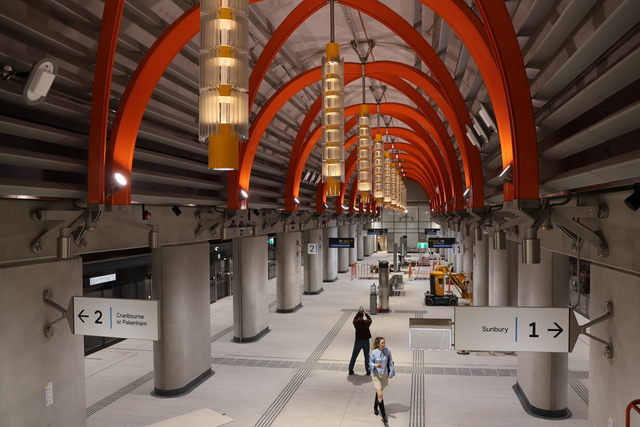
The local acknowledged that they were impressed by the modern design of the new underground stations, but she said the overall experience was stressful, confusing and significantly less convenient than before.
“We were required to disembark at Caulfield Station, on one platform, sprint through the gates, travel through the underpass, and return up to another platform to make our supposed ‘connecting’ City Loop train,” she recalled.
“With very short connection times, this was extremely difficult, and on our return journey, we were required to wait a further 20 minutes in cold weather for the next ‘connecting’ service.
“It’s not ideal for people with mobility issues. Connecting trains aren’t even on the same platforms, where you can just walk across from one side to the other.
“This additional complexity adds time, congestion, and frustration to what is already a long commute, particularly during weekday peak periods.”
Nicole’s experience was echoed by other local readers, many of whom shared similar accounts of longer journeys, forced interchanges and confusion around new transfer points following the service changes.
One reader told Star News that her husband’s trip from Cranbourne to Richmond on Sunday 1Febuary took close to 1 hour and 15 minutes after changing at Malvern, compared with about 53 minutes before the service changes.
She said the required interchange and longer waits added at least 10 to 15 minutes to journeys into the CBD.
“Given the trip into the city from the outer south eastern suburbs is already over an hour, the increased journey times and inconvenience to passengers is outrageous and unacceptable,” she said.
“The whole arrangement needs a major rethink.”
Mr Tassone said some commuters are reporting it’s adding 20 to 40 minutes a day and creating crowding pressure at interchange points.
“It’s especially challenging for people with mobility issues, prams, luggage, or those travelling to Southern Cross for onward connections,” he said.
At the same time, Mr Tassone said the feedback was not universally negative.
“Commuters travelling to the new Metro Tunnel stations in the city, and to Parkville’s health and education precincts, are seeing real benefits, with trips that can be more direct and reliable,” he said.
“Some commuters are reporting noticeable time savings and fewer bottlenecks compared with the old travel pattern.
“The government is also pointing to increased service levels on the corridor, with more weekly services overall and very frequent peak running, so there is genuine potential for improved capacity and reliability where trips align with the new stations.”
Other commuters pushed back against some of the criticism, arguing that the changes were being overstated.
One reader told Star News that the new Metro Tunnel stations effectively replace former City Loop access, with Town Hall located close to Melbourne Central, and that changing earlier for Richmond added only marginal time to most trips.
They said commuters need to learn to be organised and get used to the idea of extra steps.
Nicole said that consideration be given to operating a mixed service pattern, whereby two out of every three Cranbourne and East Pakenham Line trains continue through the City Loop and to Flinders Street, with the remaining service using the Metro Tunnel route as currently configured.
“This would allow passengers greater choice and flexibility, while still maximising the benefits of the new infrastructure,” she said.
“From a commuter’s perspective, the previous system was largely effective, aside from the need for more frequent services to meet growing demand.
“Removing direct access to the main CBD stations that the vast majority of passengers rely upon has, unfortunately, reduced the overall convenience of the service.”
A Department of Transport and Planning spokesperson said: “The Metro Tunnel is transforming the way Victorians move around our city and will free up capacity in the City Loop to run more trains across more lines.”
“Passengers using Cranbourne and Pakenham lines can consider travelling to Town Hall Station to change for City Loop and Richmond services from Flinders Street Station.”
The Department informed that Metro Trains runs hundreds of special event services every year to support passengers getting to our city’s vibrant entertainment precincts, including more trains during the footy season.
The average number of commuters with the origin of their journey at the Cranbourne station and the destination of their journey at one of the five City Loop Stations on a normal working day in Financial Year 2024/2025 was approximately 1,400.