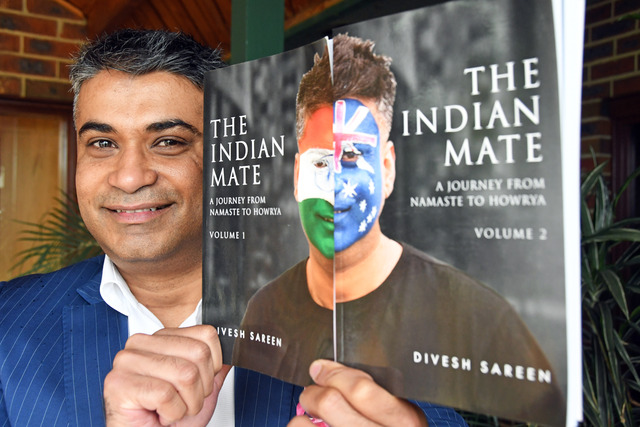
For Australians from diverse backgrounds, life is a constant adaptation with the national culture alongside the preservation of one’s home values.
For Indian-born local Divesh Sareen, this is an evolution that he revels in and explores through his many written and spoken works to support and promote the lives of migrants.
“I’m still that Aussie guy for them, and in Australia, I’m the Indian guy,” Divesh said.
The now entrepreneur, author, speaker, and community leader, Divesh came to Australia in 2008 with only a thousand dollars to his name.
That money and the support of his cousin were all he had to figure out accommodation, food and, most importantly, his student fees.
Studying for his Master of IT, he calls it “humble beginnings” to seek a life of prosperity.
“I had dreamt of coming to Australia, being from a middle-class family, you want to go to a developed country, do well for yourself and your loved ones,” he said.
“Obviously, building a life from nothing, doing all the odd jobs you can think of while you’re studying.”
Today, Divesh works for himself, predominantly consulting businesses and start-ups on IT efficiency. Most importantly, he is an outspoken advocate for Australian migrants, their stories and their contributions to Australian culture.
He is the founder of Migrants Life Foundation, which aims to highlight the challenges and celebrate the achievements of Australians from diverse backgrounds.
The foundation was kick-started by the publishing of his two-volume memoir “The Indian Mate: A Journey from Namaste to Howrya,” exploring his migrant story.
He credits his transformation from an aspiring student at Swinburne to where he is now, with his roots in the big cities of Punjab.
“India obviously got me ready for what I am today. The competition and the grind with so many people trying to succeed, trying to build skill and talent.”
India couldn’t prepare him for everything; Australia threw him a curveball, and that came in the form of love.
One fateful trip on a VLine train would see him meet Catherine, a woman who grew up in the country that Divesh would go on to marry.
Though his parent back home had high hopes with an arranged candidate for marriage, Divesh would convince them that the woman he loved, an Australian, was the person he wished to spend the rest of his life with.
He would find success in his career, working for a range of companies and learning from many mentors along the way.
But it was the want to tell stories, his own and others, of migrants’ lives that has compelled him through the years.
“The reason I was writing, to help the next Divesh, wherever he or she is, who is thinking of coming to Australia.
“What can you do to do better, capturing the legacy of people like me, all the issues of belongingness that migrants go through.”
His memoir serves as a question regarding the quandary of identity that marks a migrant’s life.
Divesh describes his himself as “not Australian enough, but I’m not Indian anymore.”
“I’m not Australian enough, in a way, because I’ve started half of my life here, half of my life there.
“And I’m not Indian anymore. Even when I go back, I don’t fit in.
“I have memories of what used to happen when I was a kid, my friends have moved on, my loved ones and relatives have moved on, and I’m still stuck there.
“I’m still that Aussie guy for them, and in Australia, I’m the Indian guy.”
Currently, Divesh is undertaking a new writing project to publish, “Tales of Global Belonging,” a collection of migrant stories all over the local community.
What he finds is that his experience is shared widely, even for second-generation migrants.
Divesh says that the children of migrants may speak English at school and have friends of many backgrounds, sharing the same values and culture.
But they still go home where they may only speak their parents’ native tongue, eat different foods and practice their own beliefs.
“No one has said to me, ‘I’m fully integrated’. Even the second generation feels that they don’t fully integrate.
“All these little things are the challenges that a lot of these migrants go through.”
A significant factor for migrants is their economic disadvantage when it comes to establishing their lives in a new country.
It’s about trying to establish greater social connections amidst the “rat race.”
“They miss all that social connection they used to have, people who think like them, people who are like them.
“And they’ve moulded themselves to be a version, to be so-called successful, to tick all those boxes.”
The book launch for “The Indian Mate,” fittingly, was at the MCG. Australia’s home of Cricket, which is possibly the strongest bridge between his country of birth and the country he calls home today.
The Cricket world certainly appreciates Divesh and his work, the launch included a special guest, cricket legend Glenn McGrath.
The launch of the Migrants Life Foundation was held at Federation Square last year, where attendees heard from 19 migrants and their unique stories.
Former fast bowler Brett Lee hosted a panel on the day, which included Pakenham’s Ravi Bhatt, director of disability service Sunshine2Sunshine.
The central message from Divesh is that though migrants should build their connections with the Australian experience, they should remember that their identity is a “superpower.”
“More towards the balanced approach of, you’ve chosen to come to Australia, you still take the initiative to be a part of that culture, appreciate that culture, not just the infrastructure and the resources that you get access to.
“But also bring your own identity, which is a superpower in a way. Like we learn from each other, the good parts and from the bad, what not to do. I think that’s a great thing.
“What happens is when migrants have a different exposure to a certain set of values, have come from a different family, probably have a different religion, and what food they eat.
“All those things are different, but at the core of it, they also crave that relationship part of it.
“So I think it’s more having those open conversations, whether it’s the locals, whether it’s the migrants who have chosen to come here and try to integrate with each other, understand each other, how we’re different, just like how we would do with our own mates who we’ve probably went to school with.”
Migrants Life has recently initiated a services tab, where people can access local help for a range of matters, with more hoped to be added.
You can see more at: migrants.life
If you are interested in pitching your story for the “Tales of Global Belonging”, you can register at migrants.life/register-for-2025/
If you wish to get in contact with Divesh for other matters, such as consulting, you can email divesh.sareen@gmail.com