Casey councillors have approved a planning permit allowing a significant reduction in parking spaces for the proposed Cranbourne Community Hub.
The decision passed 11-1 at the 9 December Casey Council Meeting, marking the first time the newly elected council had formally “called in” a proactive planning application due to its “regional significance”.
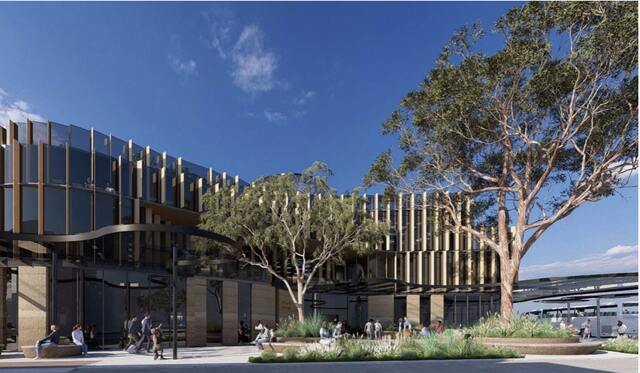
According to the officer’s report, the proposed three-storey Hub at the existing council carpark at 1-3 Lyall Street does not require a planning permit, but a reduction of the proposed carpark numbers needs a permit.
Casey Planning Scheme mandates 45 parking spaces to be provided, and the permit proposes 19 spaces, with about a 57 per cent reduction, resulting in a shortfall of 26 spaces.
Presenting the report at the meeting, City of Casey Manager Planning & Building Tania Asper said multiple technical assessments, including a Transport Impact Assessment, a Traffic Engineering Assessment, and an external independent peer review, concluded that although the shortfall would impact surrounding streets, the parking overflow could be absorbed within the precinct.
“The site is close to shops, services, schools, and public transport, making it easy for visitors to walk or use public transport,” she said.
The traffic reports also identified at least 242 off-street parking spaces within 400 metres of the site.
In addition to the proposed 19 car parking spaces, about 30 bike parking spaces are proposed.
Cr Gary Rowe, who moved the permit motion, spoke passionately about the long-awaited investment at the meeting. He even got emotional halfway through.
“Cranbourne has been without a lot of assets being built… There’s been a lack of something special,” he said.
“The building is going to be iconic in the area, and it’s something that Cranbourne has never ever had.”
He agreed with the officer’s report that the overflow parking could be absorbed within the broader precinct.
He referred to a motion he raised in May this year to request an investigation report into how to support accessibility in proximity to the proposed Hub.
“If this permit is approved tonight, officers will already be committed to investigating the pedestrians’ connectivity, parking, and any other amenity upgrades that will support the accessibility in the proximity of the Cranbourne Hub,” he said.
Cr Anthony Walter, who seconded the motion, said that building additional underground or structured parking would increase the project cost by upwards of 25 per cent, putting unnecessary pressure on ratepayers.
Cr Jennifer Dizon said rejecting the permit would create “a significant delay” and escalate costs.
“That’s unfortunately the reality we’re working with,” she said.
The lone opposing vote came from Deputy Mayor Cr Michelle Crowther, who emphasised community feedback indicating most residents intend to drive to the Hub.
“We are seeking to reduce this minimum recommended parking number by 57 per cent—not five or ten per cent, but 57 per cent,” she said.
“During the day at the Cranbourne Library, I see many mums with prams, disability groups and many older residents, groups very unlikely to be riding a bike to the Hub, unlikely to be using a public bus or be able to walk the 400 metres from the suggested alternative car parks.
“I do fear that the accessibility to this building is going to limit the success of this project.
“If this motion is moved today and the project proceeds, we need to work to improve accessibility for our community.”
Casey Residents and Ratepayers Association (CRRA) also raised concerns ahead of the meeting, warning that cutting on-site parking from 45 to 19 spaces risks undermining community access to both the Hub and nearby essential services.
CRRA president Anthony Tassone said the parking cut directly affects other essential services in the precinct, particularly the cluster of medical and allied health practices on High Street that sit immediately behind the Hub site.
“These clinics support many clients who are older, unwell or vulnerable and rely on being able to park close by,” he said.
“Their patients already depend on the limited rear car parking.
“The Hub development has already reduced some of that parking, and further cuts down to 19 spaces will make access even harder.
“Council needs to consider the broader health precinct and the real people who use these services every day.”
One clinic told Star News that the carparking at the moment had already been difficult, and people always complained about the carparking.
They believed that if the Council took the 1-3 Lyall Street carparking away, it would be more stressful for more patients unless they changed the 15-minute parking along the High Street.
Another clinic said the parking arrangement now was “fantastic” with no problem at all.
But the staff said it would be a “huge problem” if the 1-3 Lyall Street carparking was taken away.
Cranbourne Community Hub is proposed to bring together a new three-storey library, youth services, customer service, community spaces and offices in the heart of Lyall Street. It will accommodate up to 86 patrons at a time with up to 58 staff members.
The proposed 19 car parking spaces include 10 secured after-hours car spaces, seven shared car spaces, and two all-ability parking spaces.
Council has advised that the 10 secured after-hours car parks will be open to the public during business hours and will be available for the community to use.
After business hours, the secure car park will be available for staff only to use when they are working late or after the Hub closes.