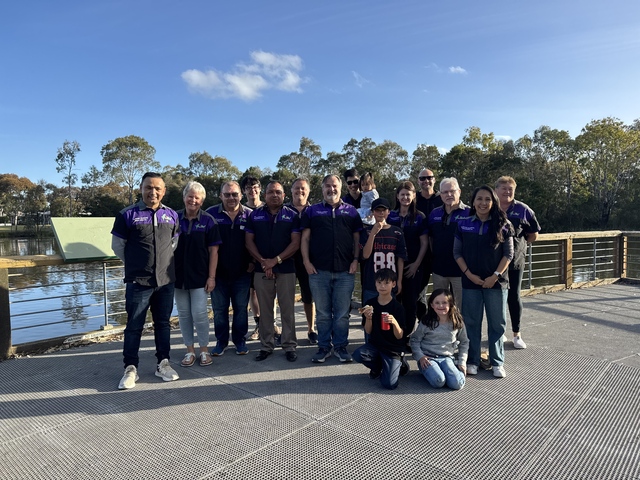
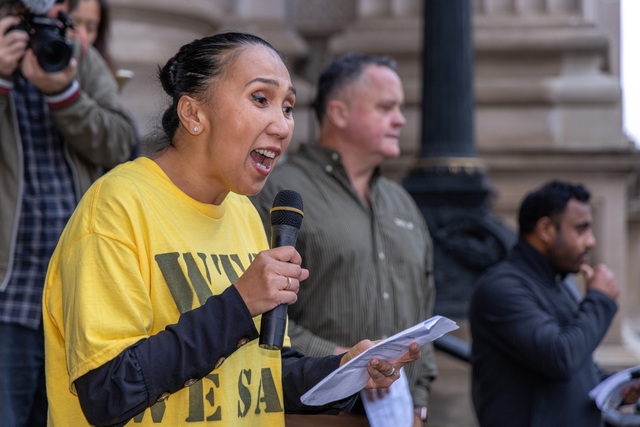
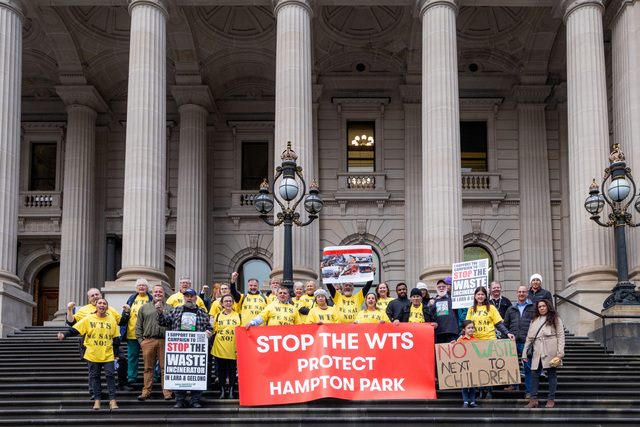
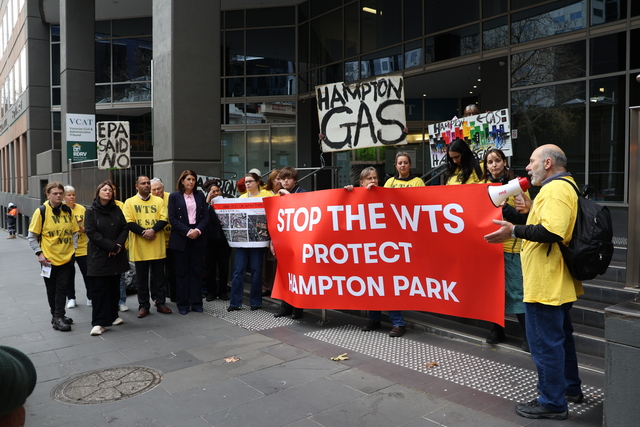
The Lynbrook Residents Association (LRA) demonstrated unstoppable determination in grassroots advocacy and community connection throughout 2025, a year marked by three high-profile protests and successful community events.
The association, led by volunteers, managed to sustain itself across two distinct fields in the past year: fighting a complex planning battle while still holding the community together through family-friendly events.
“The past few years have been full of unnecessary challenges. Our ongoing struggles with Veolia, the State Government, and the departments at the City of Casey could easily define us. They could have become the story of Lynbrook. But we refuse to let that happen,” president Scott Watson said, summing up the year at the association’s 2025 Annual General Meeting (AGM).
“Instead, we choose to define ourselves by who we are as a community.
“We continued to show up, work together, and prove what happens when ordinary people volunteer their time to do extraordinary things.”
Secretary Jason Wood, who has been involved with the LRA for nearly two decades, said the scale of advocacy in 2025 was unlike anything he had seen before.
“I’d say maybe the last couple of years, with everything that’s been happening with the landfill, the advocacy side of things has really stepped up a lot more,” he said.
“Most of the previous advocacy was around amenities, lights for the park, fixing roads, getting the parking at the station, things like that.
“We had previously been doing some high-level advocacy, but nothing to the extent of what we’ve been forced to do with the landfill and to protect the community.”
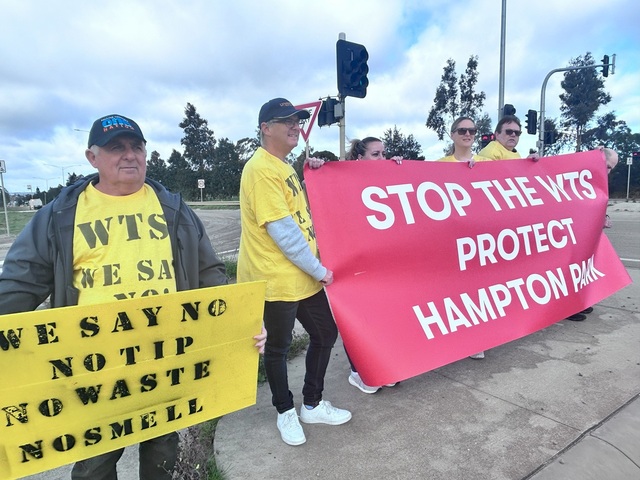
Eye of the storm was the proposed Hampton Park Waste Transfer Station by waste management company Veolia, a controversial development right next to the Hallam Road landfill.
The surrounding community has long been tired of the odour from the landfill and rejected the proposed development with concerns about fire risks, noise, increased traffic, dust, and odour. They have made their demand clear: no more industrial sites close to the residential areas.
The permit approval by the Casey Council (under administration) in late 2024 pushed the opposition sentiment to a new level. The community realised the fate of the proposed facility now lay in the hands of the Environment Protection Authority (EPA) Victoria, the decision-making authority of a development licence.
LRA quickly acted. Its volunteers doorknocked tirelessly, handed out flyers to spread the news, so that more locals could be aware of the development and its potential impact on the community.
They helped coordinate submissions to the EPA, and later liaised with other community organisations, including Hampton Park Progress Association (HPPA), and Casey Residents & Ratepayers Association (CRRA), to hold an information-oriented public forum to prepare the residents for the next move of the EPA.
EPA rejected the licence in April 2025 based on “a comprehensive, science-based assessment”, including the input from the community, but it was soon clear that the case would go to the state tribunal, as the EPA failed to decide on the licence within the required legal timeframe, despite ultimately rejecting it.
Moving forward, LRA organised three major rallies from early June to late September, from the State Parliament to support a relevant petition debate initiated by a local opposition member, to the site of the proposed facility, to show the tribunal members that they still cared and were always watching.
Apart from the big campaigns, the association took on an extensive information-sharing role, updating residents on each stage of the planning process on its Facebook page.
Committee members tracked documents, decisions and timelines, breaking down complex material and circulating summaries to help the wider community understand what was unfolding, what was next, and what could be done at each step to get their voices heard.
Treasurer Vernadette Bilbao, who became a central figure in the advocacy against the proposed waste transfer station, recalled “countless” late nights spent emailing, calling stakeholders, coordinating across communities, getting ready for the rallies, and all the other work to keep the engagement process afloat.
Vernadette was originally part of Veolia’s Hallam Road landfill Community Reference Group (CRG). One day, she was told that she should join the LRA to get more support. And she did.
A “true warrior” in the eyes of other committee members, Vernadette said she would not be able to sustain herself without the LRA core team, and everyone worked hard throughout the year.
“We’ve got a very good community that’s really vested in the best for the community, in particular when it comes to planning matters that will truly impact people. People actually would step up and help, and that keeps me going,” she said.
“There are lots of children around in our community, lots of young families in our community. We’ve already had incidents with cars on the roads, so just the increased traffic (following the development of the waste transfer station) itself is going to be a massive thing.
“My drive is more about my family and having a safe community.”
Looking back at the year, Scott said he was really proud that the association led the fight with the amount of consistent focus.
“Because we are only a small group, and we were very proud of the fact that we’ve been able to advocate for all of the other areas around and outside us,” he said.
He reflected on a moment nearly two decades earlier, when he addressed a parliamentary inquiry into urban development and warned against housing being built so close to industrial and waste facilities.
At the time, he argued that Lynbrook itself should never have been approved in such proximity to an existing landfill.
“I went on to say that if we can learn anything from it, don’t ever let it happen again. And here we are,” he said.
“We have plenty of land in this country. We don’t need to be doing that.
“It’s just lazy, convenient planning. That’s all it was.
“Basically, all of the suburbs around here have been treated with contempt. Especially if you walk around Hampton Park, it’s pure neglect, to be honest.”
Yet even as the planning battle progressed, LRA was careful not to allow the fight to overshadow everyday community life. It continued to deliver community events, including the beloved Lantern Festival, Christmas celebrations and cultural festivals that drew thousands to Banjo Paterson Reserve.
The scale of those community events has grown steadily over recent years, a shift that committee member Chris McCoy said was both rewarding and demanding.
Having helped deliver events for years, Chris said events that once attracted around 1,200 to 1,500 people had expanded into crowds of several thousand, with the Lantern Festival this year alone drawing an estimated 4,000 to 5,000 attendees at its peak.
“We all enjoy each other’s company, and we all work really well together. Everybody puts in. Nobody ever slacks off, which is really good,” he said.
“At the end of the day, especially after some big events where we’ve had 4000 to 5000 people, you’re pretty buggered.
“You’ve done a 12 to 15-hour day, and it’s absolutely crazy by the time you pack up and then run the event for the whole day.”
Across the committee, two themes consistently emerged as the foundation of the LRA’s work: the people and a shared desire to make Lynbrook a better place to live.
Committee member Nicole Gleeson recalled why she joined the LRA in the first place.
“The LRA does make an impact in our community, whether people realise it or not,” she said.
“We work behind the scenes for the benefit of the community, and I wanted to be a part of the community that makes change for the better in our area.”
She said the association was held together by friendship and a common mission.
“I used to work in hospitality, and there was this saying that our boss used to say, the team that plays together stays together,” she said.
“We don’t just get together once a month and have a meeting, and that’s it. We have all become friends.”
The sentiments were echoed by another committee member Jan Woodrow, and Jason.
“A great bunch of people that just want to do some good for the community,” Jan said.
“I just want to make Lynbrook a better place,” Jason said.
“My family has grown up here. I have friends here in my home, and I don’t just want to sit back and hope that things will happen.
“I want to be involved to try and make sure that things do happen.”
As the year closed, the LRA awaited a tribunal decision that could shape the future of the suburbs.
“I don’t know which way it will go—VCAT has not always made the most logical decisions…” Scott said at the association’s AGM.
“But regardless of the outcome, one thing is certain: we will continue the fight.
“And if that means building a war chest, launching a GoFundMe campaign, or pursuing further legal action, then that is what we will do.
“Our suburb is worth fighting for.”