
Residents and workers near St Germain in Clyde North said that more trees in growing areas would be more than a welcome addition, as the suburb has between one to five per cent of urban forest cover.
According to the Greening Casey document prepared by the City of Casey, Clyde North, both retain spots of zero per cent tree canopy coverage and have patches of six to ten per cent coverage, in addition to the mentioned one to five per cent figure.
This means commercial and industrial lands, such as those found in the eastern border suburbs, have low levels of vegetation cover as compared to parklands that retain much higher levels.
One retail staff member at St Germain Central said that “we could definitely use more trees here”.
“I know the area is new, and there are small trees around, but you know, I think trees are always beneficial for people, and of course, it would make the place look better,” they said.
One resident, who lives in close proximity to Bells Road and the shopping centre, said that Clyde North, “doesn’t have enough trees”.
“We need more trees, really, simply because it’ll make the place look better and of course, during the summer time, keep people cool,” they said.
Other residents were of like mind, with many adding that trees being put up along estates is a practice they would like to see upheld, and even boosted for future developments.
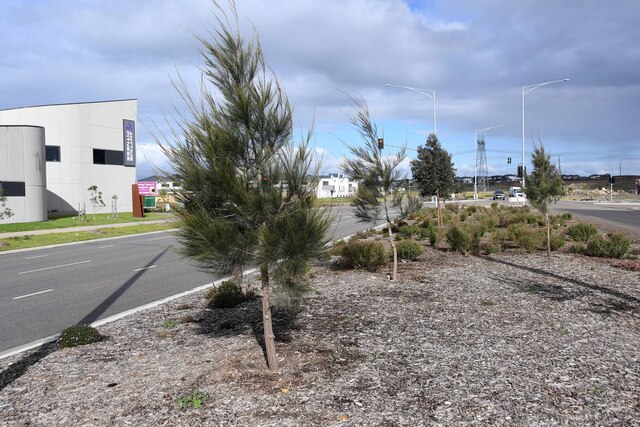
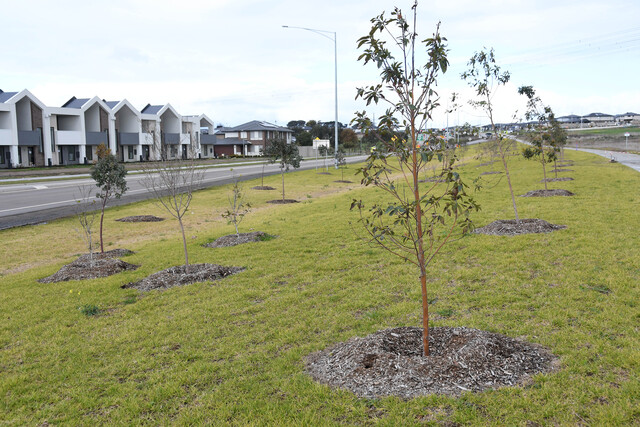
Bells Road, which cuts directly beside the shopping precinct, is home to an abundance of saplings that were planted roughly in the same timeframe as the centre was constructed.
While the species was not directly identified, the document stated that 82 per cent of street trees are juvenile or semi-mature.
This means that a significant number of trees have been planted by either the council or the developers in the last 10 to 15 years.
Overall, development is one of the major issues facing the urban forest in Casey, where the report outlined that the majority of subdivision designs do not require the provision for trees on private lots.
The report also added that there is a development driver for lot yield to maximise outcomes for developers, which often comes at the cost of open space, gardens and the environment.
Likewise, land value is valuable and becoming increasingly more so, and the highest value land use is for residential housing; trees on private lots are often seen as a construction constraint rather than an opportunity to site dwellings within the landscape.
Another retail worker in the precinct said that, as someone who recently moved to the suburb from the Mornington Peninsula, they observed a solid balance of industrial areas and homes.
“We definitely need more trees; there are so many new buildings popping up, a lot of new estates, it just feels like we need to balance it out, you know?” they said.
As it stands, the document identified 10,135 vacant street tree sites in Casey, where a tree could be planted immediately, with Clyde North identified to have swathes of 20-26 metre priority roads for tree canopy improvements.
The majority of this coverage is in the north-western suburbs, stretching in the south and south-eastern direction, whittling, until dedicated spots rise in the south, such as Tooradin, Pearcedale, and Blind Bight.
Clyde and Clyde North, however, only have small spots where trees could be planted immediately.
On the other hand, Clyde North, in the majority, on a scale of zero to 13, scored a nine when it came to priority areas in Casey for increased canopy cover.
Clyde’s north-western areas scored the same, but the remainder, due to the lack of residential development and existing farmland, scored between one to five.
This data has been cross-referenced with areas of the city where people are out and about, and therefore are more likely to be more vulnerable to heat and extreme heat events.
One worker, who drives through Berwick Cranbourne Road and Thompsons Road, said that trees alongside roads and major roads would “be an amazing addition”.
“I’m just thinking about those days in the summer when you can see the heat literally rising from the ground.
“Now imagine if you had some shade, it would be nice, you know? And obviously it would be good for the environment,” they said.
Minta Estate in Berwick South, and just north of the border of Clyde North, began with an eight per cent coverage in 2018, and saw growth from existing trees and new plantings.
However, this was significantly outweighed by the subsequent removal of existing trees and heavy pruning, where overall canopy decreased by almost 20 per cent of the original, resulting in a 2022 baseline of 6.5 per cent.
In 2021, the canopy cover was measured at 6.1 per cent, which is a decrease in canopy cover, at a rate of -17.63 per cent, as compared to what was measured in 2018.
The document states that this type of loss is occurring in many estates throughout the city, which significantly impacts Casey’s ability to adapt adequately to climate change, mitigate urban heat impacts and provide liveable neighbourhoods for future communities.
Each year, the council plants approximately 3000 street trees for renewal and infill, 2000 open space trees, and 20,000 tubestock in conservation areas.
This comes with regular tree inspection programs for street and park trees, significant trees and nature reserves, as well as bushlands.
As mentioned in a previous article, the goals for greening Casey include 15 per cent tree canopy cover overall by 2030, 20 per cent cover over roads by 2050, and 30 per cent cover over parkland/open space by 2050.
Overall, focus areas include wide road reserves with low canopy cover (including those owned by VicRoads), activity or retail centres, walking and cycling paths, carparks, streets and roads surrounding schools, public gardens and semi-natural parcels of open space, and streets and open spaces linking areas.